
Florida fishing intelligence — Snook
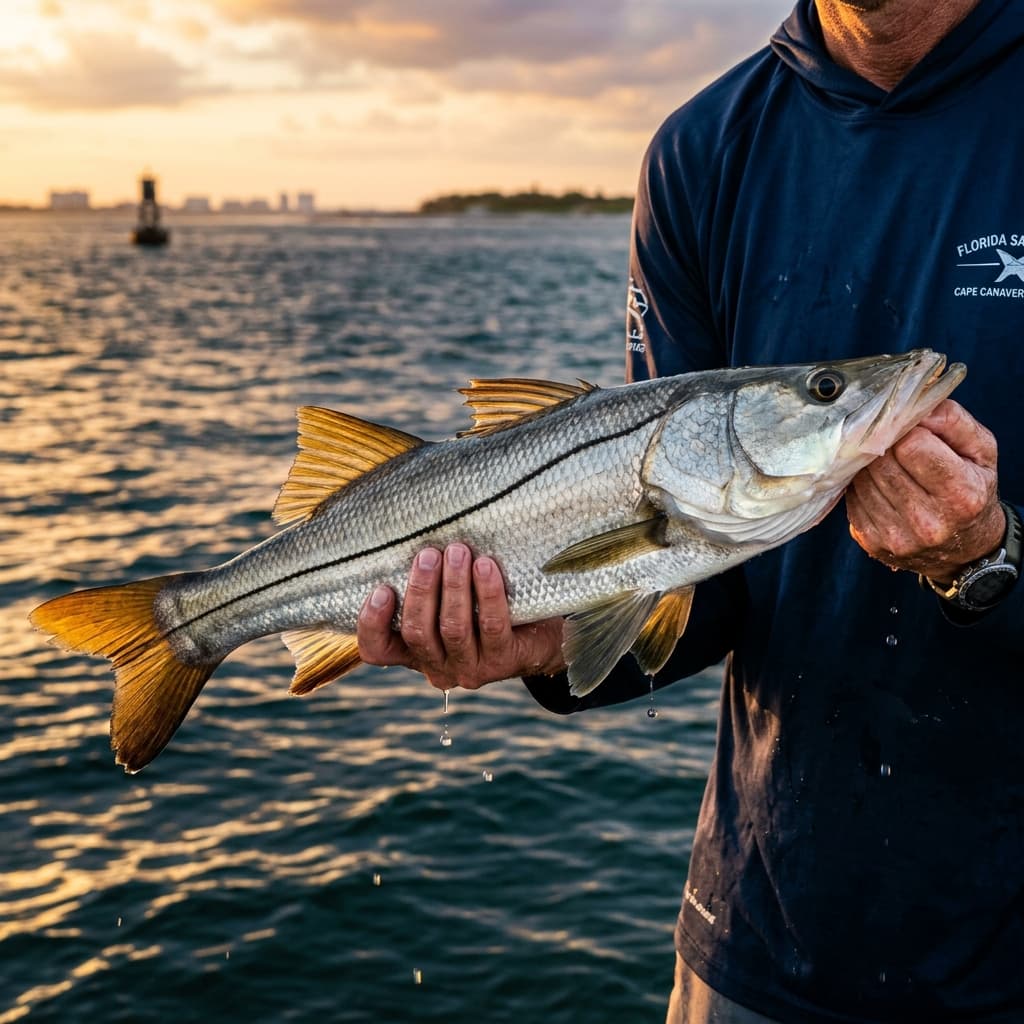
Snook
Fish edges, current seams, and low-light bait movement instead of blind fan casting.
East coast harvest is seasonal and permit-based; on April 17, 2026 the east coast harvest window is open.
Species Almanac
FWC Regulations
East coast harvest is seasonal and permit-based; on April 17, 2026 the east coast harvest window is open.
Verify current rules →Seasonal Pattern
Best months to plan around Snook.
Where To Find Them
Mapped Bite Atlas spots grouped by region.
Indian River & Lagoon
Daytona & Volusia
Tampa Bay & Gulf Coast
Treasure Coast & Palm Beach
Spot-Specific Tactics
How anglers target Snook at mapped spots.
Free-line a live pin fish or finger mullet with no weight on 20 lb fluorocarbon leader along the current seam during dusk or after dark. Fish the change in current direction, not the center of the flow. Set the drag loose — they'll run.
September through November when mullet are running the beach. Throw a 4-inch white paddletail on a 3/8 oz jighead with 30 lb fluoro leader on 15 lb braid. Parallel the beach at first light. The hit feels like you snagged a log that starts moving.
Fish a live pinfish or large shrimp on a 3/0 circle hook with 30 lb fluoro leader, free-lined with no weight. Cast upcurrent of the seam where moving water breaks off the riprap structure. Let the bait drift naturally into the eddy. Snook sit facing into the current and ambush from behind the rocks.
6–8 inch white or chartreuse paddletail on a 3/4 oz jighead, 40 lb fluoro leader on 30 lb braid. Cast upcurrent and let the bait swing through the shadow line created by the catwalk lights. The hit will feel like you snagged the bottom — then the bottom will start running. Keep the drag set at 25% of line strength.
Focus on the creek and channel mouths on outgoing tide. Snook stage at the point where moving water meets open flat. Live finger mullet free-lined or a 4-inch paddletail on 20 lb fluoro. Fish the last 2 hours of outgoing — that's when the concentration peaks.
Live mullet or 5-inch white paddletail on 30 lb fluoro leader. Cast upcurrent and let the bait sweep into the shadow line created by bridge lights. Snook face into the current on the shadow/light edge waiting for bait to silhouette. Set the drag to 30% — they'll run for the pilings immediately.
Heavy 3/4 oz jighead with a 6-inch paddletail in white or chartreuse on 40 lb fluoro. Cast upcurrent and bump the jig along the bottom near the rock edges. Snook ambush from the rock crevices. The hit feels like a hard stop — set immediately and reel hard to keep them out of the rocks.
Wade the Gulf-side flats at first light in knee-deep water. Use a 4-inch white or chartreuse paddletail on a 1/4 oz jighead with 25 lb fluoro leader. Cast along the beach parallel to shore. Snook cruise the edge where sand meets grass. The hit will be sudden and explosive — keep your drag set properly.
Fish the exact edge where bridge light meets shadow with live whitebait (scaled sardines) or a 5-inch white paddletail on a 3/8 oz jighead and 30 lb fluoro leader. Snook face into the current sitting on the shadow side, ambushing bait that gets silhouetted in the light. Cast upcurrent and let the bait drift into the zone. The eat is a sudden, jarring stop.
Skip a live shiner, pilchard, or select shrimp as far under the dock shade as you can reach. Use a #1 or 1/0 circle hook, 20 lb fluorocarbon leader, and no extra weight unless current forces it. Let the bait swim naturally and keep the rod low so the first run does not saw you off.
Free-line a pilchard, shiner, or select shrimp along the shaded side of the pier on moving water. Cast upcurrent and let the bait sweep naturally into the shadow. Close the bail early because the first pull is straight back to the pilings.
Walk quietly and cast a white or natural paddletail parallel to shore in the first trough. Keep the lure inside the drop, especially at first light. Most beach snook are within a rod-length or two of the sand.
At first light or late afternoon, walk slowly and throw a small white paddletail or live pilchard parallel to the sand. Keep the bait in the trough. Stop when you see shadows, then cast ahead of the fish instead of at it.
Large live mullet (8–12 inches) on a 5/0 circle hook with 50 lb fluoro leader on 40 lb braid. Free-line along the jetty rocks on outgoing tide. Snook sit in the rock crevices and ambush from the downcurrent side. Fish from sunset to 2 AM for the best window. Keep the drag tight — they'll wrap you around the rocks.
Large live mullet (8–10 inches) or oversized swimbaits (6–8 inch) bumped along the jetty rocks on outgoing tide. 50 lb fluoro leader on 40 lb braid. Fish the shadow lines where rock structure meets open water. Night from 9 PM to 2 AM is the prime window for trophy-class fish.
Live pilchard or sardine on a 3/0 circle hook with 25 lb fluoro, free-lined in the light/shadow edge cast from the pier. Snook sit on the dark side of the shadow line facing into current, ambushing bait that gets illuminated. Fish from 9 PM to midnight for the most consistent window.
Free-lined live pilchard, pinfish, or shrimp on a 3/0 circle hook with 30 lb fluoro leader. No weight — let the current carry the bait through the pass. Cast upcurrent from the pier and let the bait swing through the snook feeding lane. The bite is an explosive surface strike or a deep pulling grab. Snook run toward structure — keep pressure on immediately.
Live pilchard or finger mullet free-lined on a 3/0 circle hook, 30 lb fluoro. Wade to the reef edge at last light and let the bait drift through the snook holding lane. Snook push bait against the reef structure at dusk — the bite is fast and aggressive. Keep light pressure to avoid break-offs on the reef.
Recommended gear
Tackle matched to these tactics and conditions.
Owner Mutu Light Circle Hooks (2/0-4/0)
The gold standard for live bait fishing in Florida. Light wire for better hook penetration, circle design for clean jaw hookups. Use 2/0 for shrimp, 3/0-4/0 for mullet and pilchards.
DOA Shrimp 3" (Natural) 3-pack
The most productive artificial bait in Florida inshore history. Weight-forward design gives a natural fall. Free-line it, put it under a cork, or slow-hop it on a jighead. It just works.